Teague McDaniel and Fawn Atencio
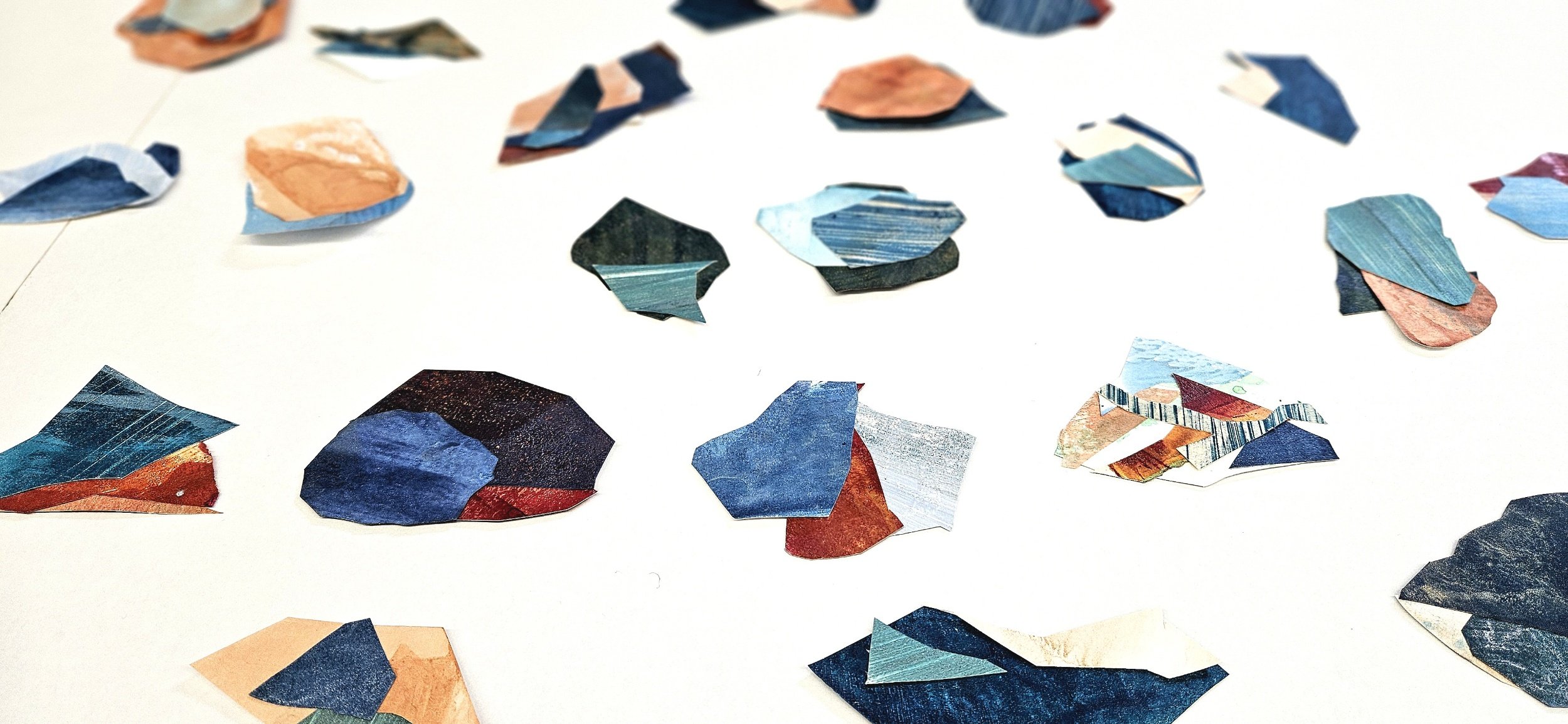
100 small gifts
Through Nikki Pike’s BARTter Collective, we created over 100 small pieces of art as gifts to be gifted at Adams County Pride. These prints are inspired by Waldron Bates' cairns, they serve as a metaphor for hopeful path making, and finding the way in an unprecedented time in the united states.
June 2026
Kimberly Ritchie and Fawn Atencio
Concerns about water supplies, water quality, and access to clean water are growing across the globe. Climate change is making these challenges more complex, and in our region we can expect the future to bring more extreme storms, longer periods of drought, changes in our snow load, and many other impacts that will change the systems we depend on to live.
To address these challenges we need to understand and be inspired by the stories data tells us about the changes in the world we are seeing.
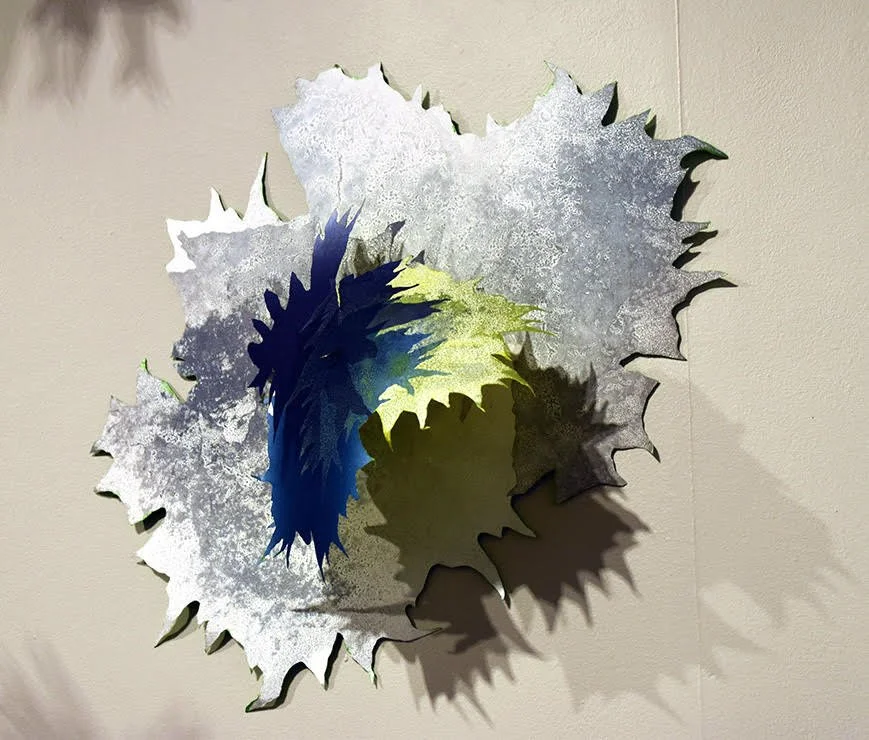
Using collographs to print images of disappearing bodies of water, we hand cut the delta like images and install them as objects, further abstracting the disappearing evaporating shapes that impact water in the west.
Exhibition at Plymouth State University, Fall 2024
Delta
Kimberly Ritchie and
Fawn Atencio
Delta
The Colorado River delta is a dramatically transformed landscape after the Dam was built in 36. Historically, the head of the delta was where the Colorado River emerges from a narrow valley approximately 21 km upstream from the confluence of the Gila and Colorado rivers near the Laguna Diversion Dam.
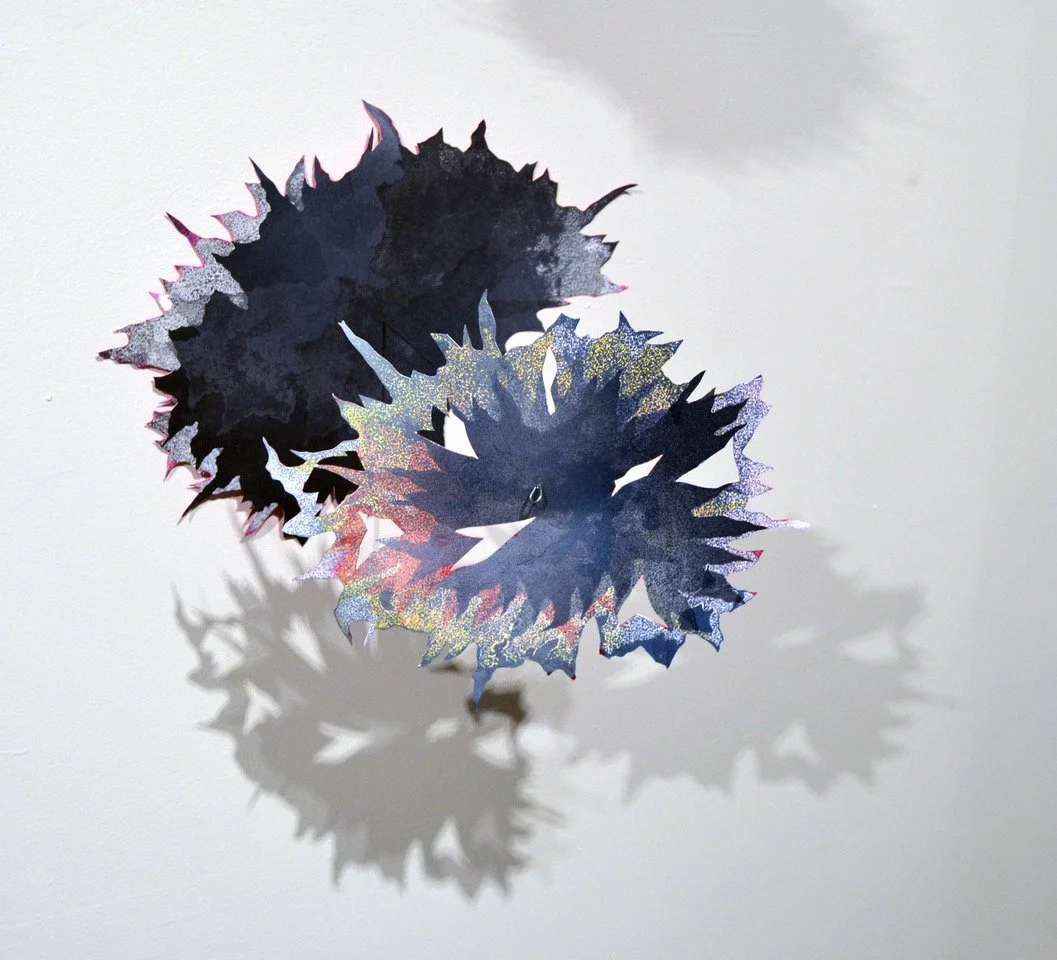
Using collograph plates to print images of disappearing bodies of water, we hand cut the delta like images and install them as objects, further abstracting the disappearing evaporating shapes that impact water in the west.
Handcut collographs, litho ink on paper attached to wire.
Kimberly Ritchie
and
Fawn Atencio
Delta
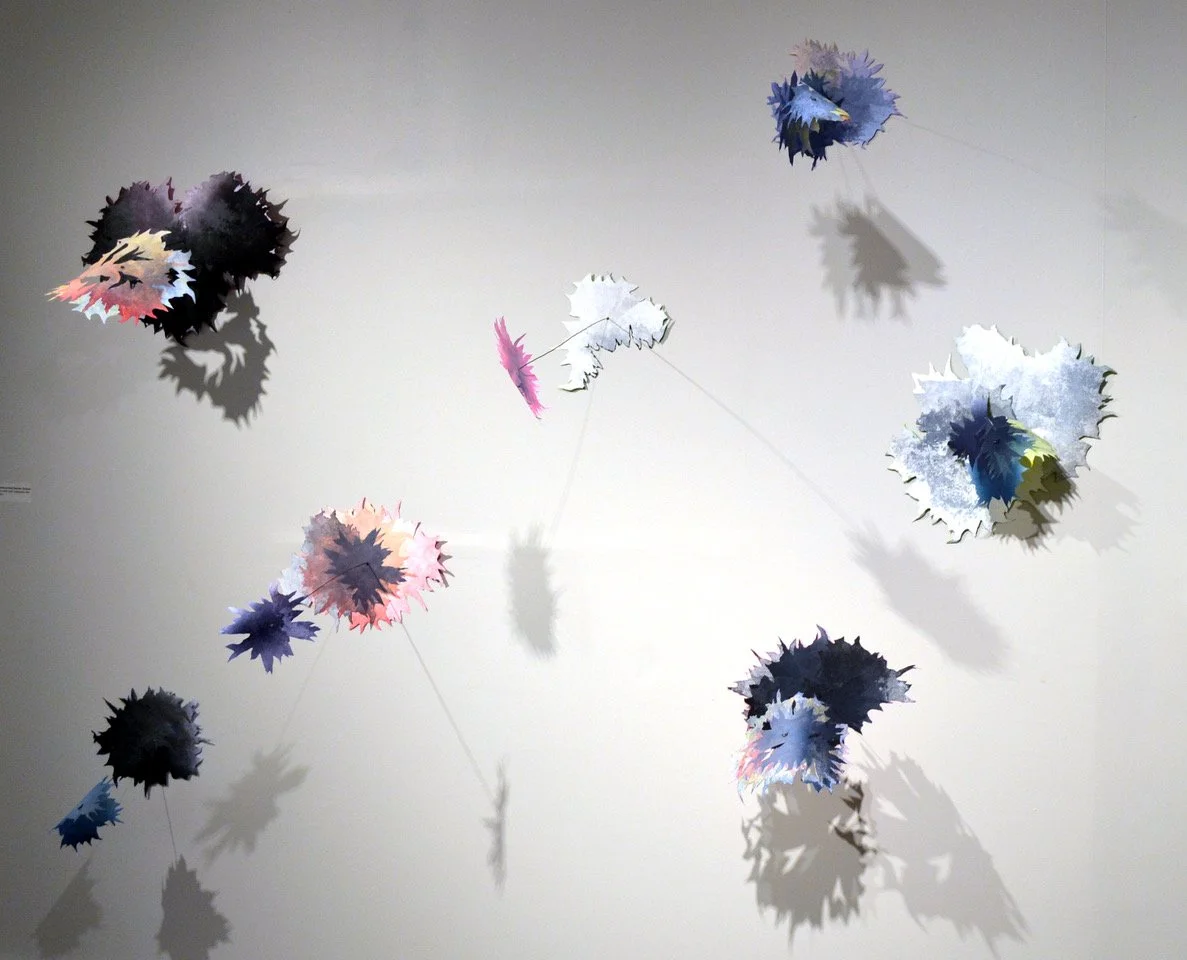
Drawing, painting, printmaking, and wire.
Detail shot of installation.
Collective Whereabouts
at the Denver Art Museum
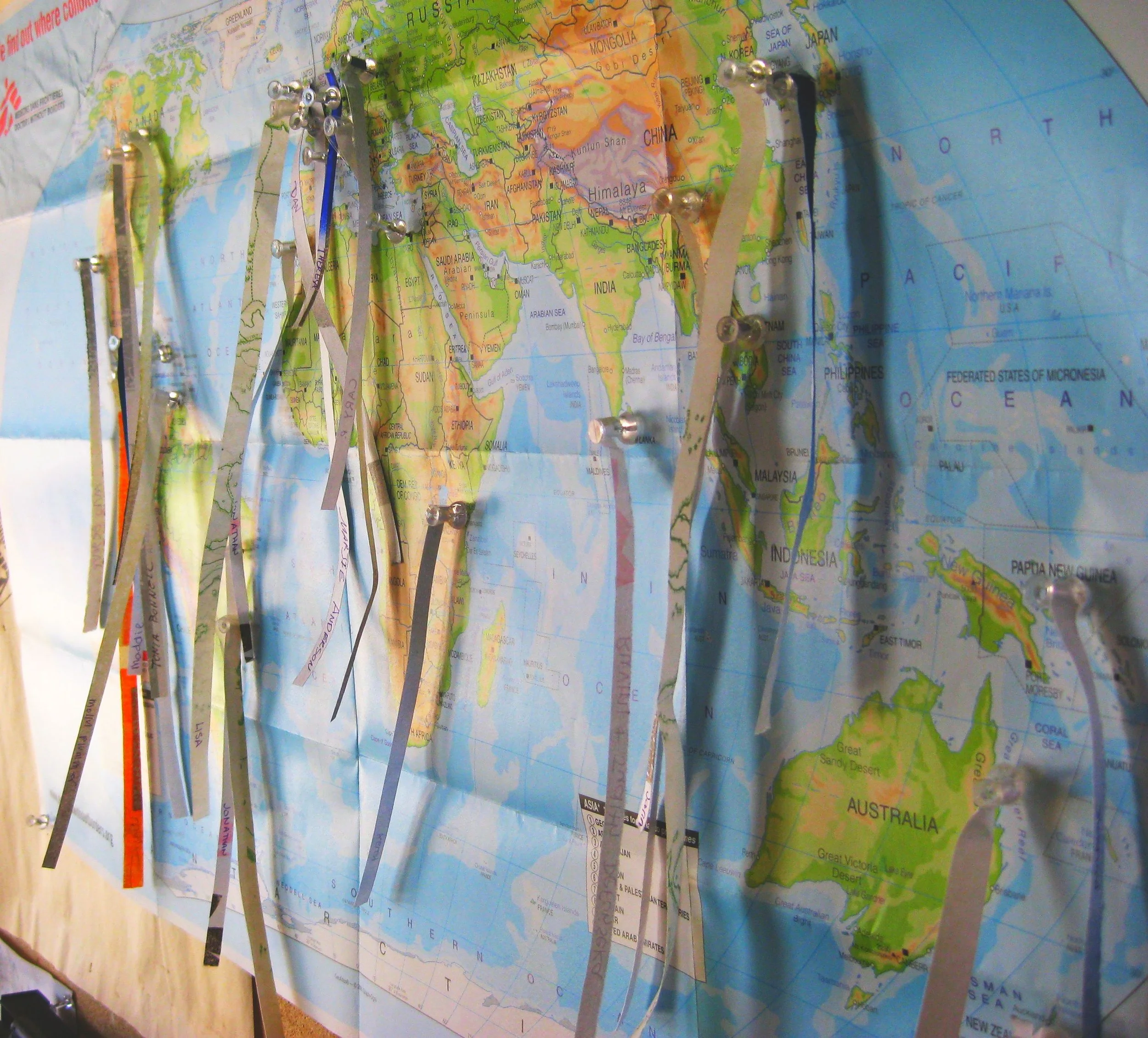
In celebration of the Month of Printmaking, this project was a collaborative effort asking gallery viewers to take a strand of printed material from discarded print proofs that were part of the process for the show, and mark a place that they have visited or lived outside of the United States. This prompted the community to discuss various geographies and experiences the audience had. This project was originally in tandem with the exhibition “Place: A Travel Memoir” in 2011.
That exhibition led to the“Collective Whereabouts” proposal: an ongoing art project which engages viewers to discuss place, travel and home. This project has been rewarding, and was revived at the Denver Art Museum in 2019 as “Collective Whereabouts”.
Collective Whereabouts
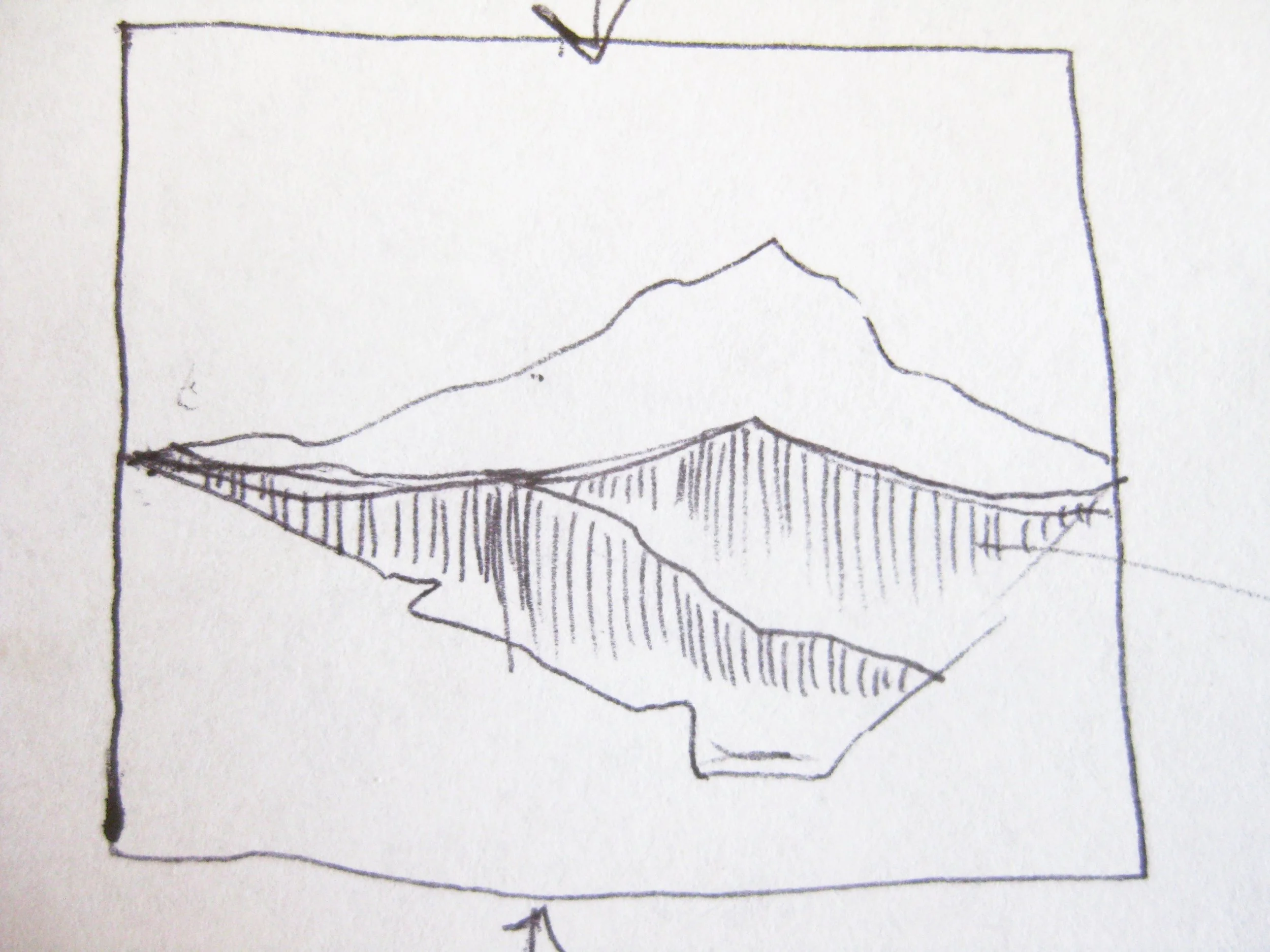
Collective Whereabouts is a project which asks viewers at the Denver Art Museum to participate in the making of an art piece. Each person was asked, “What brought you to Colorado?” The sketch shown here of what this could look like once community adds to the large print. Layers of stories build texture, colors, and a newfound composition. In the addition of paper, stories, and interactions with others, we construct a collective whereabouts.
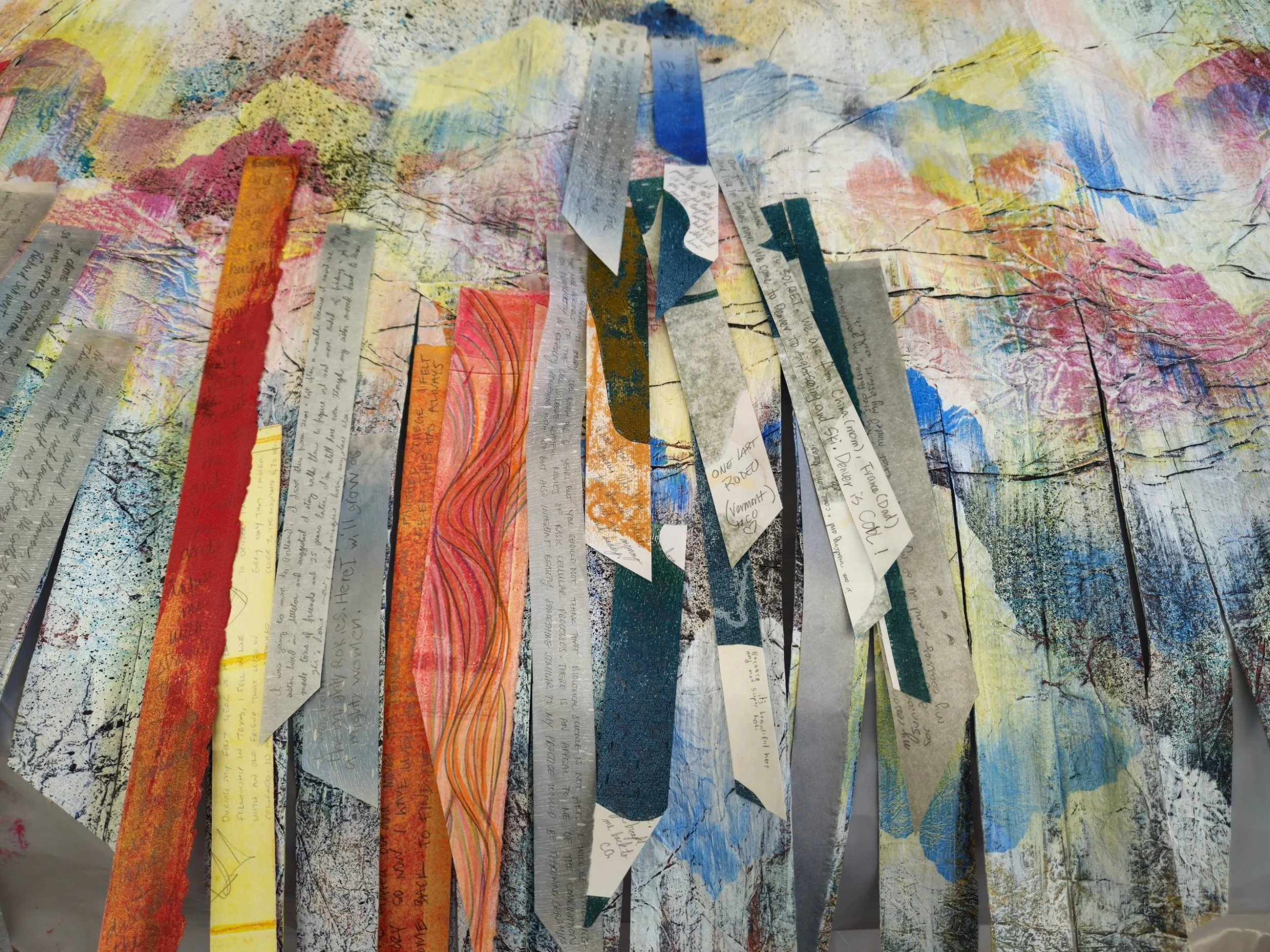
Collective Whereabouts
(Detail)
Observers become makers by attaching cut pieces of hand pulled prints to a larger handmade mountain shaped structure. Layers of stories build texture, colors, and a newfound composition. In the addition of paper, stories, and interactions with others, we construct a collective whereabouts.
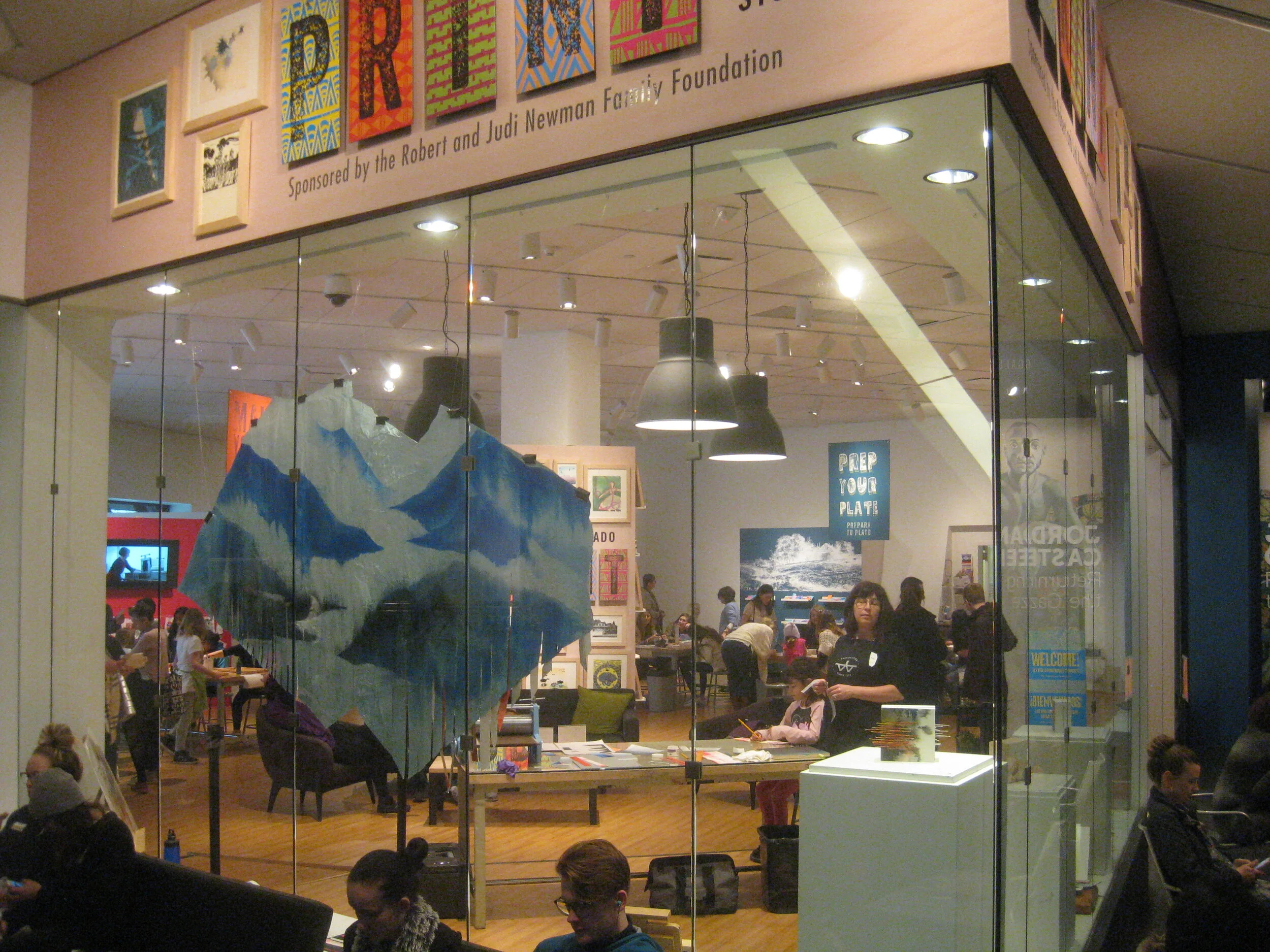
Collective Whereabouts
At the end of the day before the DAM closes with installation prep for Collective Whereabouts.
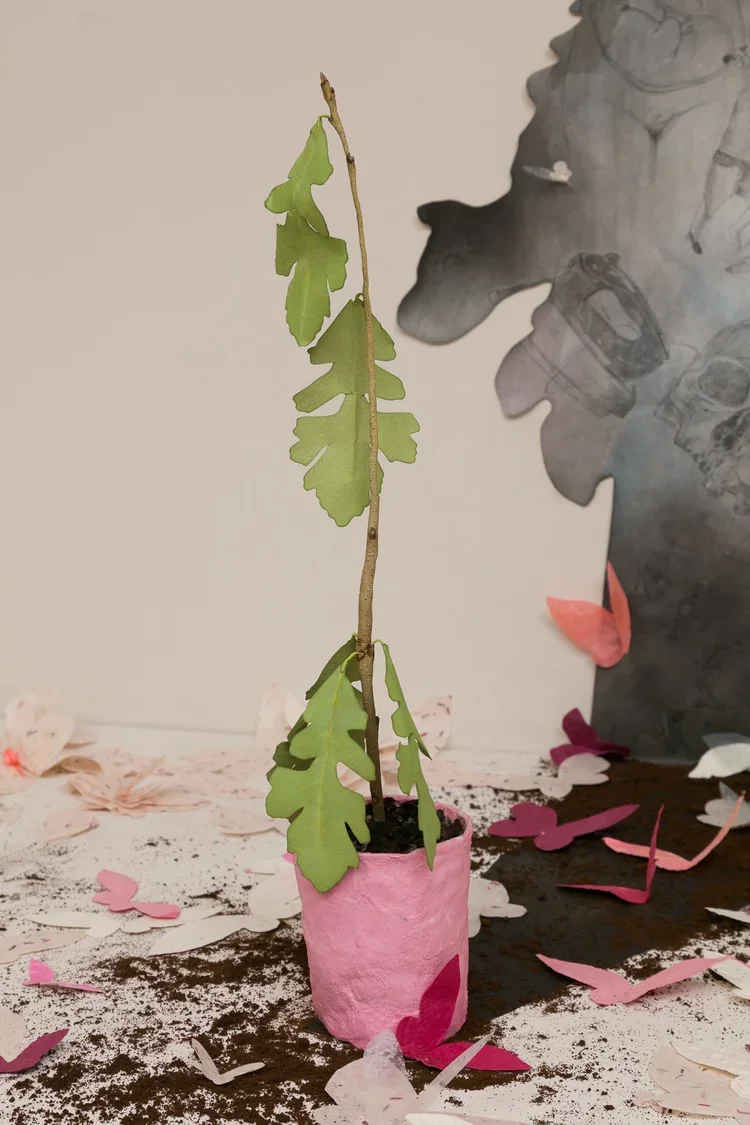
Pink Progression
“Cosaint”
Detail
Cosaint contains a tormenting shadow that is overpowering a small seedling. The sapling represents hope for a bright and just future and the need to grow into a large, strong and protective force. The towering shadow embodies a discriminatory and prejudicial present and past. In the shadow, racism, sexism and classism are addressed. If we don't confront our biases and the mistakes of our past, how can we expect to create a future devoid of them?rflies, Handmade paper Plant, Drawing and Painting
The Arvada Center, March, 2020
Pink Progression
“Cosaint”
Cosaint contains a tormenting shadow that is overpowering a small seedling. The sapling represents hope for a bright and just future and the need to grow into a large, strong and protective force. The towering shadow embodies a discriminatory and prejudicial present and past. In the shadow, racism, sexism and classism are addressed. If we don't confront our biases and the mistakes of our past, how can we expect to create a future devoid of them?
Honored to Collaborate with Sarah Wallace Scott, and Bonnie Stolzman.
Dimensions Variable
500 paper butterflies, Handmade paper Plant, Drawing and Painting
Arvada Center, March, 2020
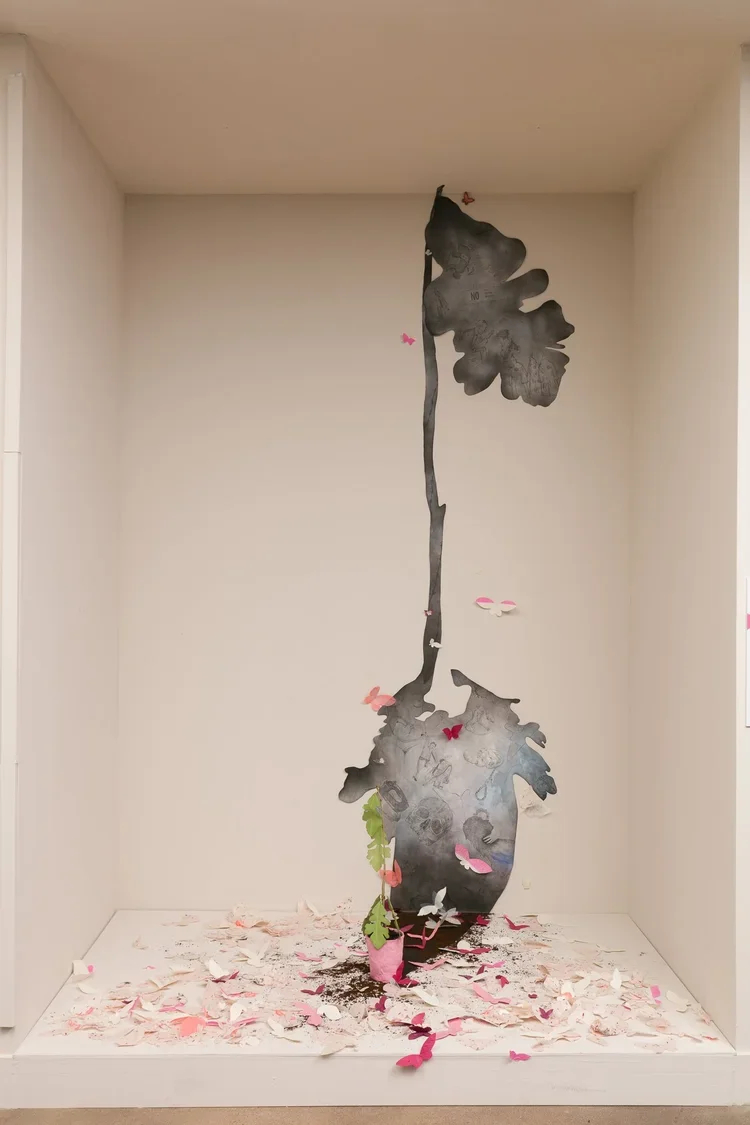
“Camouflage”
Collaboration with Susan Vaho, for
“Pink Progression”
12 × 12”
Paper, Paint, Glass and bolts
Curated by Anna Kaye, CVA 2016
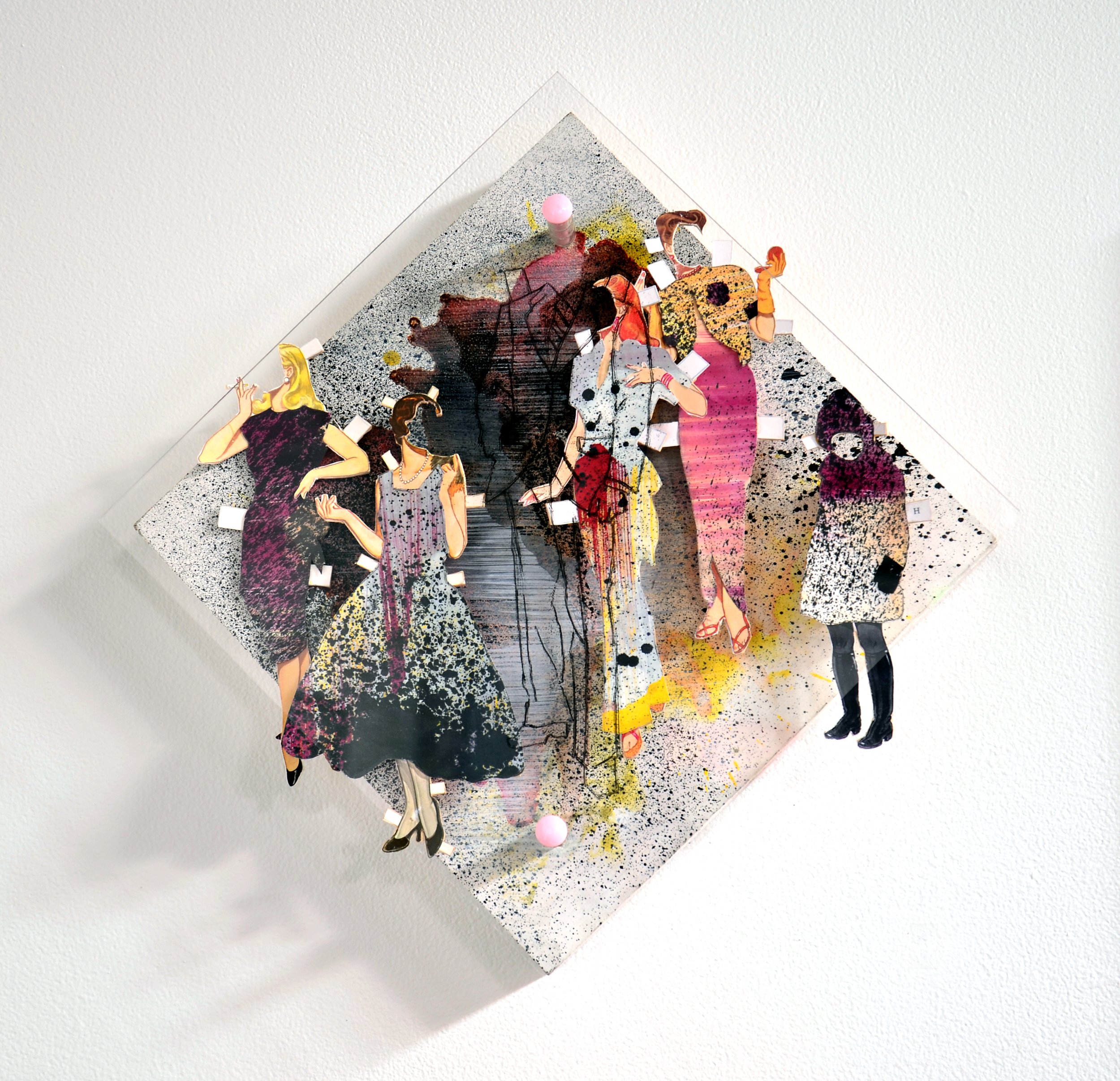
Conveners
In Celebration of the month of printmaking. Curated by Sarah Wallace Scott and Chinn Wang
Featuring: Imin Yeh, Molly Bounds and Sidney Masuga; Jenny Robinson and Nancy Mintz; John Hitchcock and Jenny Angus, Imin Yeh,Matthew DiClimente, Catherine Chauvin and Fawn Atencio, Jenny Schmid and Tim Krause
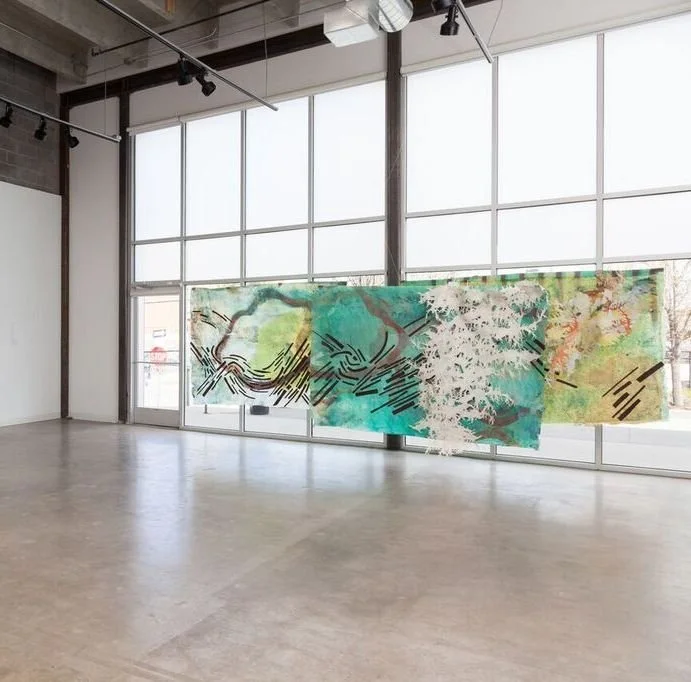
Alternate Path
Hand made paper; hand cut, digitally cut, graphite, relief print.
Fawn Atencio and Catherine Chauvin combine low tech / high tech print processes which result in a visual dialogue on nature and landscape, its power and destructiveness as well as its beauty. Interpreted by the two artists, and using a contemporary lens, the work uses environmental changes as metaphors for life events and examine cultural traditions which use water as a catalyst for change.
Handmade Kozo Paper, Acrylic, Litho Ink, and more Paper
5 × 24’
Where Land and Water Meet
Land and Water is a 20 lithograph exploration about interpretations of affected public lands and altered bodies of water. Using Colorado as a point of departure, these landscapes appear carved or diminished, but carry a visual beauty and an insistent content beyond the edges of the paper. This is the first collaboration of two professional printmakers who live and work in Denver, Colorado.
Each artist has been addressing landscapes through a contemporary lens: Chauvin, looking at man’s land use, manipulations ranging from logging, to preservation and paths through spaces. Atencio, looks at how water behaves as it creates paths, patterns, and connections to the land it intercedes. The prints are significant in that each artist uses a combination of low tech (monotype, relief) and high tech (lithography, digital) print processes, which convey a curiosity and concern for land and water issues in a unique and thoughtful manner.
2015
The Average Path Length
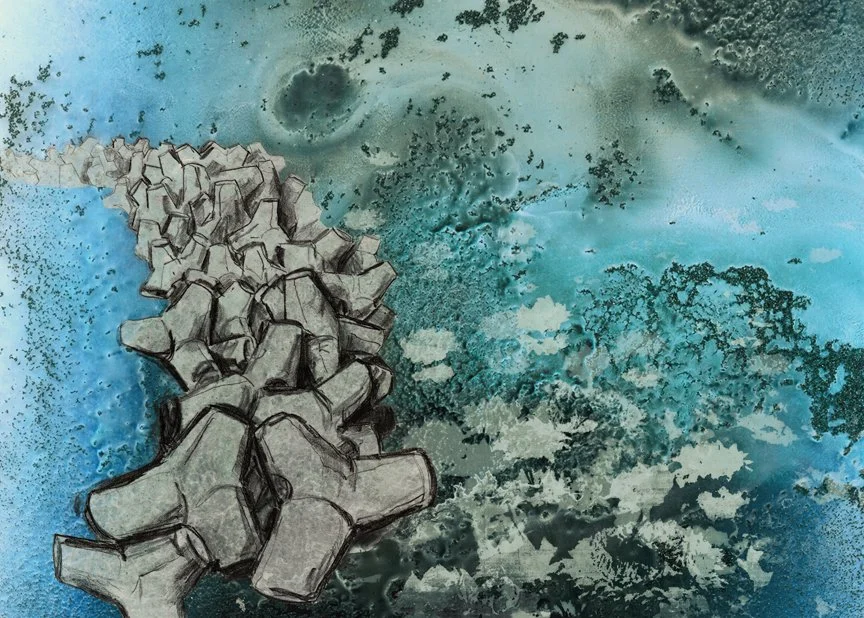
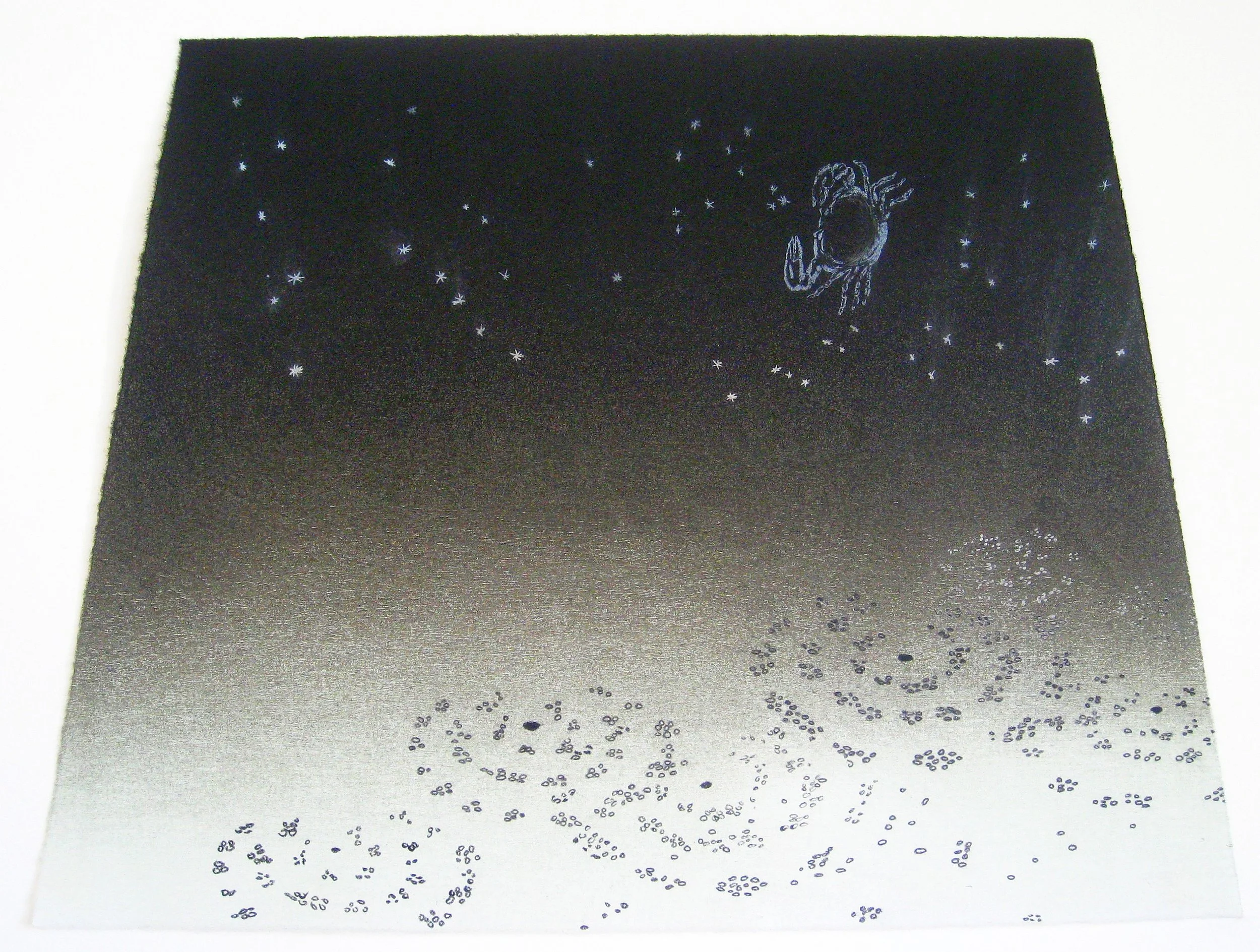
Small world experiments designed by Stanley Milgram and other researchers in the 1960's examined the size and connectedness of social networks of people in the United States. The research was revolutionary; it offered that human relationships can be represented as paths connecting nodes (individuals). The distance between individuals can be measured by the number of paths (or relationships) they are from one another. Thus we have the idea of six degrees of separation; the average path length between any two people in the world is six relationships from each other.
Lithograph, wood grain relief on BFK.
Traveling to: Southern Graphics Conference International: MKE Conference, Milwaukee WI
Southern Graphics Council International Archives, Knoxville, TN.
20 Invited Artists Respond to “Average Path Length”
Curated by Fawn Atencio
Route 66: Westbound to Paradise
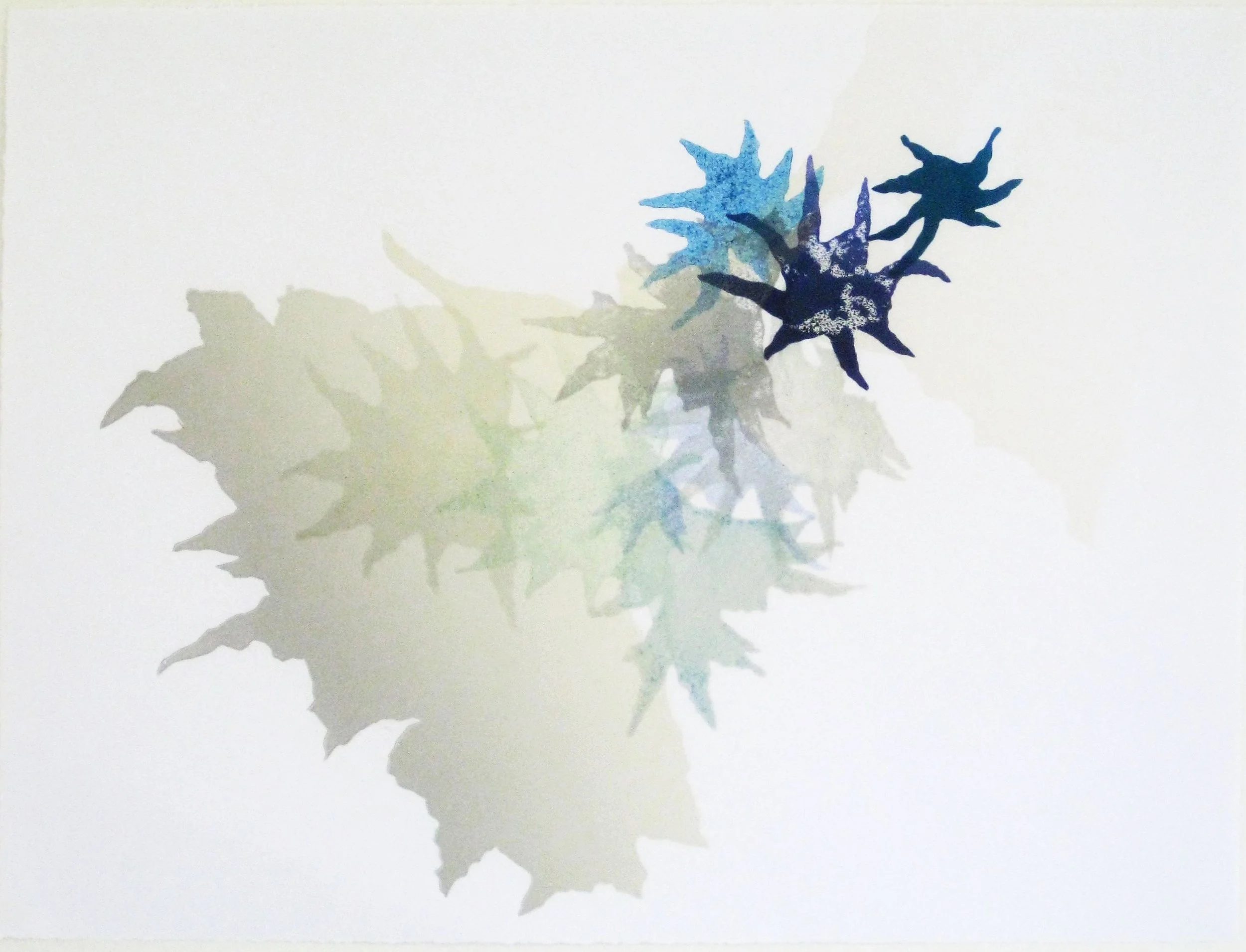
Route 66, also known as the road to opportunity, linked Chicago to Los Angeles between 1926 and the mid 1950's. The road functions as a metaphorical bridge, connecting the country socially and culturally, bringing people to paradisaical California. The road enabled over 200,000 people to migrate to California, escaping the Dust Bowl. After World War II, thousands of soldiers and sailors sought the perfect climate and plentiful jobs on the West Coast. Once again Route 66 facilitated their relocation. As people migrated along the route, it served as a cultural conduit, transporting ideas, progressive thinking, and diversity westward. The road to opportunity led to California, a place for a better life and where paradise could be found.
Portfolio exchange participants were asked to provide their own take on Route 66 Westbound to Paradise, taking into consideration Route 66, the road to opportunity as a catalyst for social change. 2014
“Westbound to Paradise”, invitational portfolio exchange: Denver, CO, Organized by Fawn Atencio, artist: Denver, CO
Travelling to:
Mid America Print Council Conference: Detroit, Michigan Fall 2014,
Arizona State University: Tempe, Arizona,
California State University-Northridge: Northridge, California,
Kansas City Art Institute: Kansas City, Missouri,
Plymouth State University: Plymouth, New Hampshire,
The University of Central Oklahoma: Edmond, Oklahoma,
The University of Texas at El Paso: El Paso, Texas,T
Tyler School of Art, Temple University: Philadelphia, Pennsylvania
Slowness
Curated by Mary Hood, 36 artists, curated by Mary Hood, debut at the Southern Graphics Council International Conference: Atlanta, GA.
In Collaboration with Catherine Chauvin
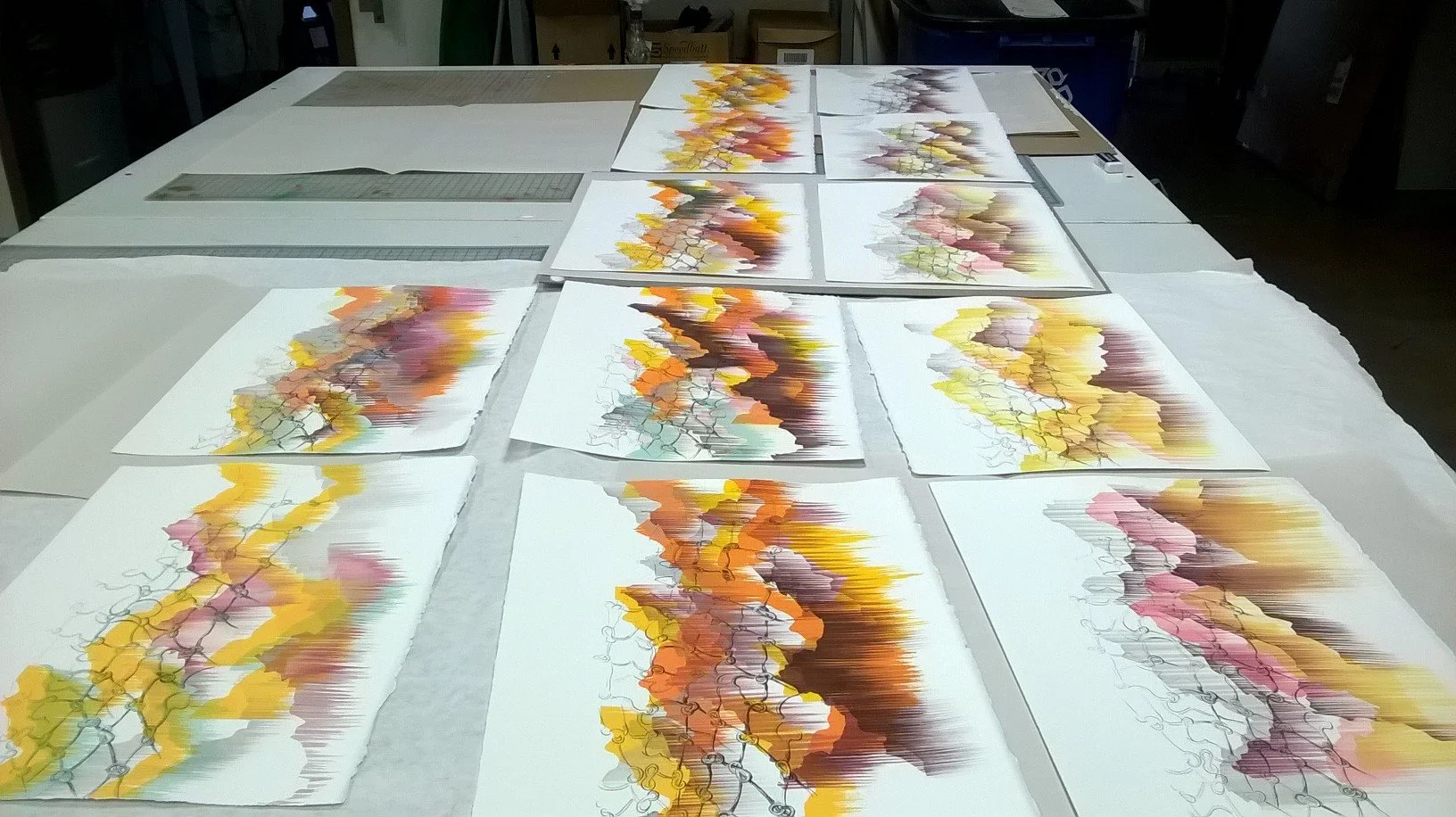
The prints for Slowness have a human made element that interrupts a landscape.
For Chauvin, Slowness, became about process, and the evolution of a collaborative relationship.
The net layer had to be a hand drawn stone lithograph. The drawing had its own evolution, starting with climbing net knot instructions, screen printed onto fabric, because what makes a better drawing subject, than a layered image to draw?
For Atencio, what makes a better slowness project, than several layers of dye, screenprint ink washes and handwork in combination with a lithograph?
The prints are a varied edition of 15, incorporating stone lithography, screenprint and hand work with watercolor on Rives BFK.
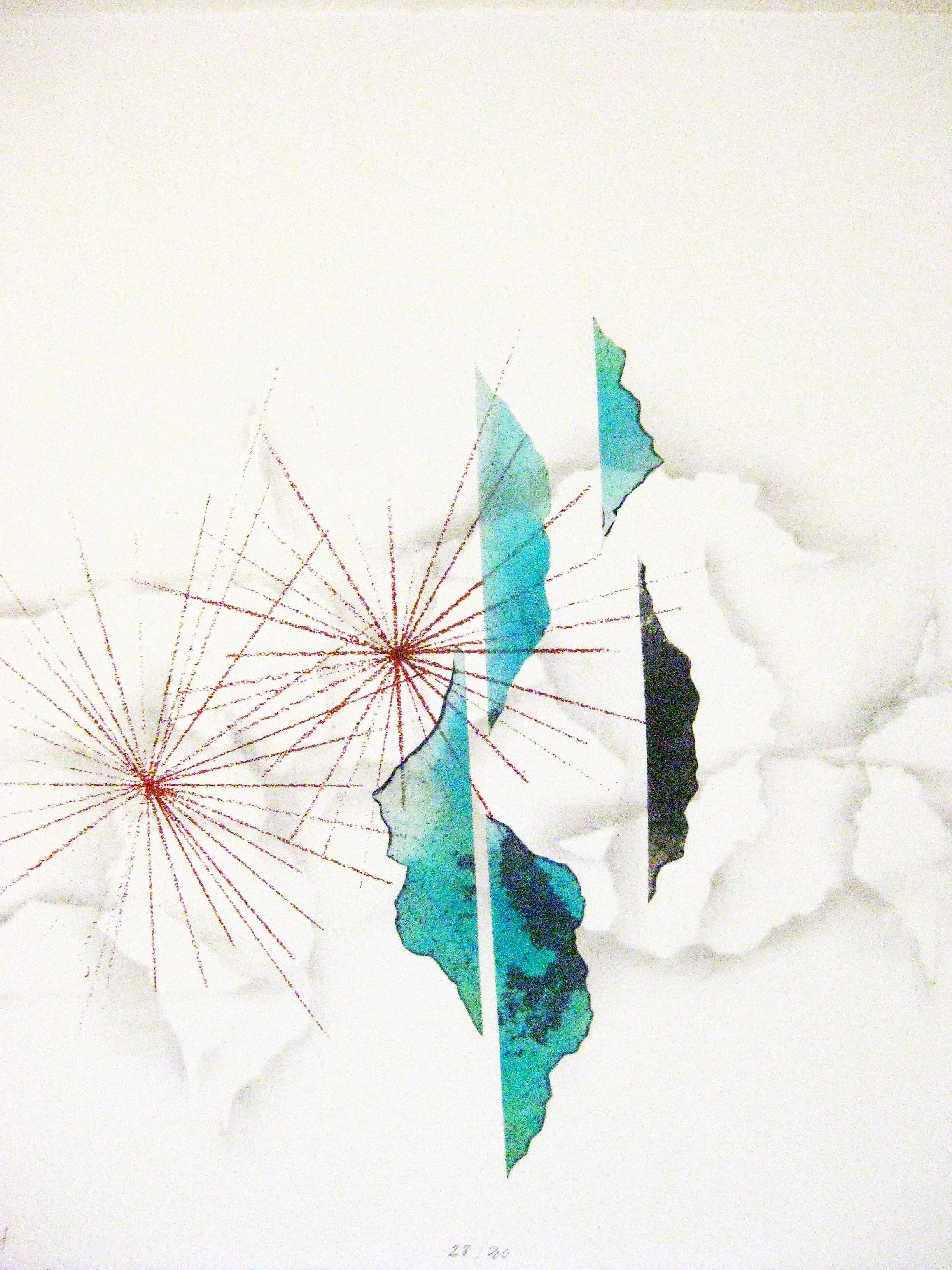
The Butterfly Effect
In 1961 MIT meteorologist Edward Lorenz began contributing to a branch of mathematics known as chaos theory in an attempt to predict weather patterns. Chaos theory is the study of systems in which small changes to initial conditions, yield large differences in outcomes. Consider releasing a bowling ball down a lane. A wide variety of outcomes are dependent on slight differences in the ball's initial position, speed, and spin (among other things). Lorenz coined the phrase “the butterfly effect” to describe his work on chaos theory. He suggested that the flapping of a butterfly's wings might precipitate a hurricane on the far side of the world. That is, a small change to the existing meteorological conditions might have a large effect on the state of the weather system.
For my edition of prints for the exchange, I chose to discuss the glare of light we now have in our backyard after losing two 100 year old black maples. After losing them to disease - due to climate change- all plants in our yard died. They were used to shade. It changed an oasis to a glaring hot dessert.
As the curator, I asked 20 artists to respond to the prompt, the butterfly effect.
“Butterfly Effect”, invitational portfolio exchange: Denver, CO
Organized by Fawn Atencio, artist: Denver, CO
Traveling to: Southern Graphics Conference International: Knoxville, TN
Arizona State University: Tempe, Arizona.
Kansas City Art Institute: Kansas City, Missouri
Tyler School of Art, Temple University: Philadelphia, Pennsylvania